

Root Cause vs Symptom Treatment: Functional vs Conventional Medicine
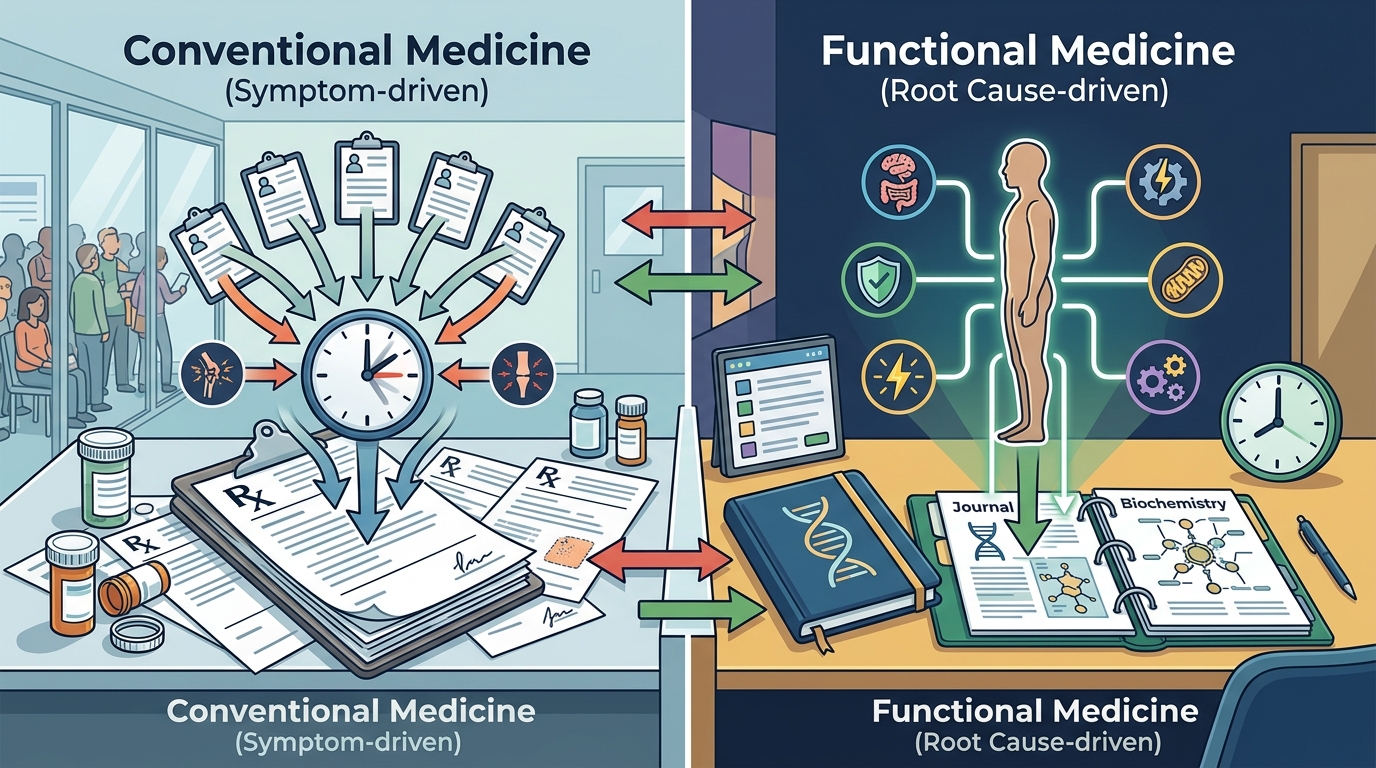
Traditional healthcare systems often prioritize rapid symptom suppression over long-term physiological restoration. According to recent industry analyses, the conventional model treats an average of 2,000 patients per physician annually, which severely limits the time available for deep diagnostic inquiry. This structural constraint creates a gap in care for individuals managing complex, chronic conditions that do not respond to standard pharmaceutical interventions. Functional medicine addresses this gap by shifting the clinical focus from disease management to health optimization. (Finding Functional Medicine Expertise)
What Is Functional Medicine?
Functional medicine is a systems biology-based approach that focuses on identifying and addressing the root cause of chronic disease. Rather than viewing the body as a collection of independent organs, functional medicine treats the patient as an integrated whole. This model recognizes that symptoms are often the result of complex interactions between genetics, environment, and lifestyle factors. (Functional Medicine Integrative Functional)
At Direct Integrative Care, we utilize this framework to uncover the underlying imbalances that fuel conditions such as autoimmune disorders, metabolic syndrome, and hormonal dysregulation. By mapping the patient's unique history and biological data, we can create a personalized roadmap for recovery. This approach is not merely about treating a diagnosis but about restoring physiological function and resilience. (Functional Medicine Integrative Functional)
Functional medicine is a patient-centered clinical practice that looks beyond the standard label of a disease to understand the individual's unique biochemical needs. It relies heavily on detailed history taking and advanced diagnostic testing to guide therapeutic decisions. This method ensures that interventions are tailored to the specific physiological pathways that are malfunctioning in each patient. (San Antonio Texas Direct)
The Limitations of Conventional Care
Conventional medicine, often referred to as allopathic or acute care, excels in emergency situations and acute trauma. It is highly effective for stopping bleeding, setting broken bones, and treating acute infections. However, its utility diminishes significantly when addressing chronic, multifactorial diseases. The primary limitation lies in the time-constrained visit structure, which rarely allows for the exploration of lifestyle, environmental, or genetic contributors to illness. (A Functional Medicine Approach)
In the conventional model, physicians are often incentivized to see a high volume of patients to maintain financial viability. This volume-based model means that a typical appointment lasts only 10 to 15 minutes. Such brief interactions make it nearly impossible to discuss complex lifestyle changes or review extensive lab data in detail. Consequently, patients are frequently prescribed medication to manage symptoms without addressing the underlying trigger.
Furthermore, conventional medicine often operates in silos. A cardiologist treats the heart, a gastroenterologist treats the gut, and an endocrinologist treats the hormones. This fragmentation ignores the interconnectedness of these systems. For example, gut inflammation can directly impact cardiac health and hormonal balance. Without a holistic view, these connections remain untreated, leading to persistent health issues.
Key Differences in Approach
The divergence between functional and conventional medicine is fundamental. It is not just a difference in technique but a difference in philosophy. Understanding these distinctions helps patients make informed decisions about their healthcare providers and treatment plans.
| Feature | Conventional Medicine | Functional Medicine |
|---|---|---|
| Primary Focus | Disease management and symptom suppression | Root cause identification and health restoration |
| Patient Panel Size | High volume (1,500+ patients per physician) | Low volume (e.g., capped at 99 patients) |
| Visit Duration | 10-15 minutes | 60-90 minutes for initial assessments |
| Diagnostic Tools | Standard lab ranges and imaging | Advanced functional labs and genetic testing |
| Treatment Strategy | Pharmaceuticals and surgery | Diet, lifestyle, supplements, and targeted therapies |
| Provider Availability | Appointment-based, limited access | Direct access via phone or text between visits |
Diagnostic Methodology and Testing
One of the most significant differentiators is the depth of diagnostic inquiry. Conventional medicine relies on standard reference ranges for lab tests. If a value falls within the "normal" range, it is often deemed healthy, even if it is not optimal for that specific individual. Functional medicine utilizes advanced testing to identify subclinical imbalances before they manifest as full-blown disease.
We employ tools such as NMR lipoprotein analysis, comprehensive stool microbiome panels, and genetic testing for variants like APOE and LPL. These tests provide a granular view of metabolic function, gut health, and inflammatory markers. For instance, high triglycerides may be flagged in conventional care only when they exceed 150 mg/dL. In functional medicine, we look at the ratio of triglycerides to HDL cholesterol to assess insulin resistance and metabolic risk much earlier.
This rigorous diagnostic approach allows us to detect issues like thyroid dysfunction, adrenal fatigue, and nutrient deficiencies that standard panels often miss. By identifying these root causes, we can intervene before the condition progresses to a stage where it requires lifelong medication. This proactive stance is central to the functional medicine philosophy.
Treatment Philosophy and Interventions
Treatment in functional medicine is highly personalized. While conventional medicine often follows a one-size-fits-all protocol for a given diagnosis, functional medicine recognizes that two patients with the same diagnosis may have completely different underlying causes. For example, two patients with hypothyroidism may require different interventions based on whether the cause is autoimmune, nutritional, or environmental.
Our treatment plans typically involve a combination of dietary modifications, targeted supplementation, stress reduction techniques, and sleep optimization. We use food as medicine to reduce inflammation and support gut healing. For patients with conditions like Mast Cell Activation Syndrome (MCAS), we may implement an anti-inflammatory diet alongside mast cell stabilizers like Ketotifen or Low Dose Naltrexone (LDN).
Supplementation is not arbitrary. We use specific dosages of omega-3 fatty acids, magnesium, and berberine based on clinical evidence and individual lab results. This precision ensures that interventions are effective and safe. We also monitor progress through follow-up labs every 3 to 6 months to adjust the plan as the patient's physiology changes.
The Direct Care Membership Model
The traditional insurance-based model creates barriers to the kind of deep, continuous care that functional medicine requires. To overcome this, Direct Integrative Care operates on a direct care membership model. This model allows us to cap our active patient panel at 99 individuals. This cap ensures that every patient receives the time, attention, and availability they deserve.
By limiting our panel, we can offer weekly visits when needed, rapid responses to questions via phone or text, and access to advanced testing without the bureaucratic hurdles of insurance claims. This model aligns our incentives with your health outcomes rather than the volume of services provided. It fosters a true partnership in health where communication is open and continuous.
This approach is particularly beneficial for those navigating complex health issues. Whether you are managing an autoimmune flare, seeking fertility support, or optimizing performance, having a dedicated provider who knows your history is invaluable. It eliminates the frustration of repeating your story to new providers and ensures continuity of care.
Key Takeaways
- Root Cause Focus: Functional medicine seeks to identify and treat the underlying causes of disease, not just the symptoms.
- Personalized Care: Treatment plans are tailored to the individual's unique biology, genetics, and lifestyle.
- Advanced Diagnostics: Utilizes comprehensive testing to detect subclinical imbalances before they become chronic diseases.
- Low Patient Panel: Direct care models cap patient numbers to ensure deep engagement and accessibility.
- Lifestyle as Medicine: Diet, sleep, and stress management are primary therapeutic tools alongside supplements.
- Continuous Access: Patients have direct communication with their provider between scheduled visits.
- Holistic View: Treats the body as an interconnected system rather than a collection of isolated organs.
Frequently Asked Questions
Is functional medicine covered by insurance?
Functional medicine services are often provided through a direct care membership model, which may not be directly billed to insurance. However, many patients use flexible spending accounts (FSAs) or health savings accounts (HSAs) to pay for these services. Some lab tests may be reimbursable depending on your plan.
How is functional medicine different from naturopathy?
While both approaches value natural healing, functional medicine is practiced by medical doctors (MDs) and doctors of osteopathic medicine (DOs) who have completed rigorous medical training. It integrates conventional medical knowledge with advanced functional testing and therapeutic strategies.
Can functional medicine cure chronic diseases?
Functional medicine aims to put chronic diseases into remission by addressing their root causes. While it may not "cure" genetic conditions, it can significantly reduce symptoms, improve quality of life, and prevent progression by restoring physiological balance.
What kind of testing is used in functional medicine?
Functional medicine uses advanced testing such as comprehensive stool analysis, food sensitivity panels, genetic testing, and specialized hormone and lipid profiles. These tests provide a deeper insight into metabolic and immune function than standard lab panels.
How long does it take to see results?
Results vary depending on the individual and the condition. Some patients report feeling better within weeks, while others may take several months to fully resolve complex issues. Consistency with the treatment plan is key to achieving lasting results.
Do you accept new patients?
We maintain a small patient panel to ensure quality care. We typically accept only two new patients per month. Interested individuals should contact us directly to check current availability and schedule a virtual assessment.
What is the cost of functional medicine care?
The cost varies based on the membership tier and the specific services required. We provide transparent pricing for our direct care model, which includes unlimited access to the provider and discounted lab testing. Contact us for detailed pricing information.
Begin Your Health Journey
If you are tired of managing symptoms without finding answers, it is time to explore a different path. Functional medicine offers a comprehensive, personalized approach to healing that addresses the root of your health challenges. At Direct Integrative Care, we are dedicated to helping you achieve lasting wellness through evidence-based, root-cause medicine.
Take the first step toward a healthier life. Complete our Virtual Assessment Form to schedule your consultation. You can also reach our team directly by calling or texting (210) 981-6106. We look forward to supporting you on your journey to optimal health.