
Integrative Oncology Telemedicine in Texas: A Functional Medicine Guide
Integrative Oncology
The Role of the Consultative Physician
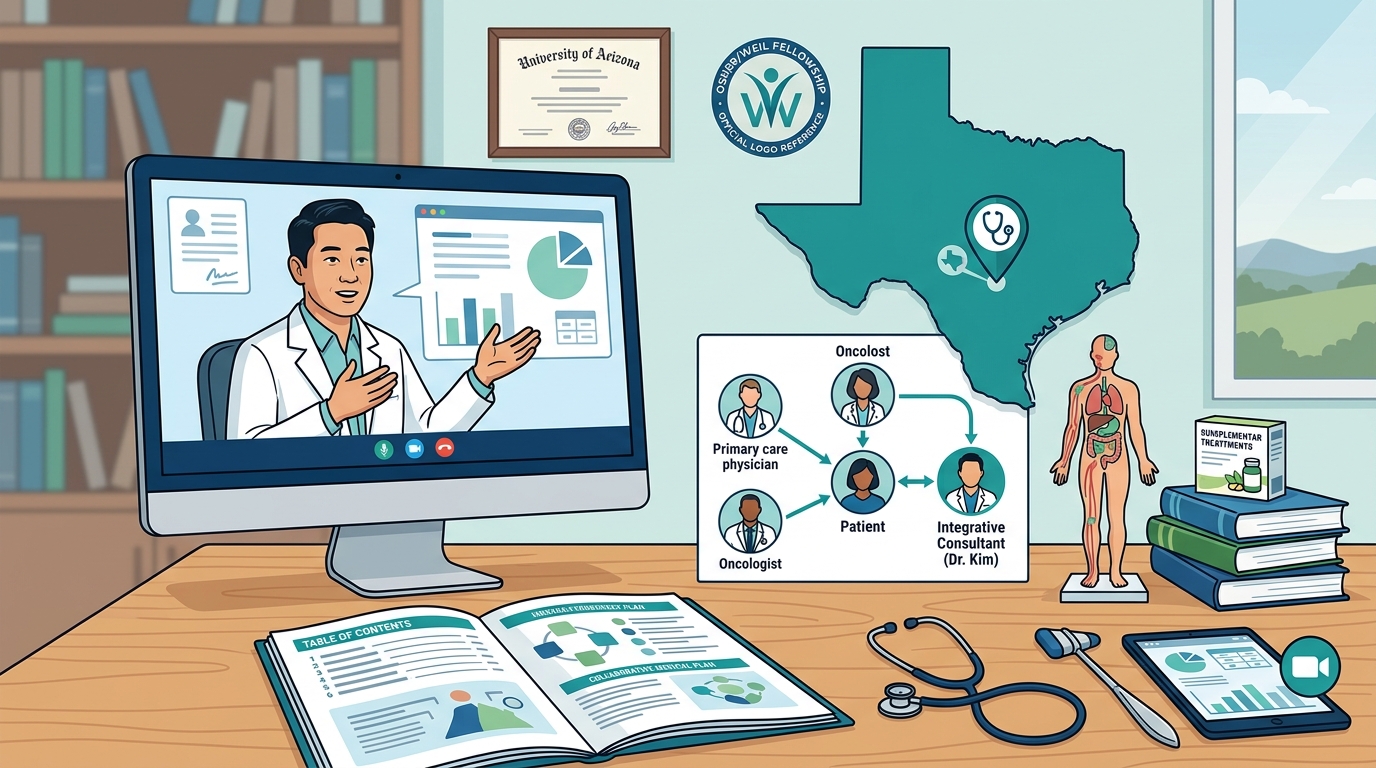
The consultative physician is a medical professional who works in coordination with, but not as a replacement for, your primary care or oncology team. This role is critical in complex cases where multiple specialists are involved. Dr. Kim acts in this capacity, ensuring that integrative strategies align with your existing treatment plan. This coordination prevents conflicting advice and ensures a unified approach to your health. For additional details, review the Functional Medicine Integrative Functional.
Managing Treatment Side Effects
Functional Medicine
Functional medicine is a systems-based approach to healthcare that focuses on identifying and addressing the root causes of disease. It moves beyond symptom management to explore the underlying mechanisms of illness. This approach utilizes detailed history taking and advanced laboratory testing to create a personalized care plan. For patients with complex conditions, this depth of analysis is often essential. For additional details, review the .
Root Cause Analysis
Advanced Laboratory Testing
Telemedicine Licensure
Telemedicine licensure is the legal requirement for a physician to hold an active medical license in the state where the patient is physically located during the consultation. This rule applies to all telehealth providers in the United States. It ensures that patients receive care from a licensed professional within their jurisdiction. Direct Integrative Care operates in specific states where Dr. Kim holds active licenses. For additional details, review the Customer Experience.
Licensed States for Direct Integrative Care
Direct Integrative Care currently serves patients in Texas, Iowa, Illinois, Missouri, Georgia, and Florida. You must be physically located in one of these states at the time of your video or telephone consultation. If you are traveling, you must be in a licensed state to receive care. This ensures compliance with state medical board regulations. For additional details, review the Frequently Asked Questions.
Telemedicine-Only Model
The telemedicine-only model is a practice structure where all clinical services are delivered via secure video or telephone. No physical examinations, procedures, or in-person treatments are performed as part of the membership. This model allows for greater accessibility and continuity of care. It is particularly useful for patients who travel frequently or live in areas with limited specialist access. For additional details, review the About.
Low-Dose Naltrexone
Immune Modulation
Immune modulation is the process of adjusting the activity of the immune system to restore balance. LDN is believed to act as an immune modulator rather than a simple suppressant. It may help regulate the activity of mast cells and other immune cells. This can be beneficial for patients experiencing immune-related side effects from cancer treatment.
Pain Management
Pain management in oncology is a critical aspect of quality of life. LDN has been studied for its potential to reduce chronic pain, including neuropathic pain. It works by influencing opioid receptors in the central nervous system. Many patients report improved comfort and reduced reliance on other pain medications. This therapy is monitored closely through telemedicine consultations.
Comparison of Care Models
| Feature | Conventional Oncology | Integrative Functional Medicine |
|---|---|---|
| Primary Focus | Tumor reduction and survival | Root cause analysis and symptom management |
| Testing Scope | Standard pathology and imaging | Advanced functional labs and immune markers |
| Delivery Method | In-person and telehealth | Telemedicine-only (Direct Integrative Care) |
Key Takeaways
- Integrative oncology works alongside conventional treatment, not as a replacement.
- Functional medicine focuses on root causes using advanced testing.
- Telemedicine licensure requires the patient to be in a state where the doctor is licensed.
- Direct Integrative Care serves Texas, Iowa, Illinois, Missouri, Georgia, and Florida.
- Low-dose naltrexone is an off-label therapy for immune modulation and pain.
- The practice is membership-based and insurance-free, offering transparent fees.
- Dr. Kim is board-certified in Preventive Medicine with an IFM Scholar designation.
- All services are delivered via secure video or telephone consultation.
Frequently Asked Questions
Does Direct Integrative Care replace my oncologist?
Which states can I receive care in?
You must be physically located in Texas, Iowa, Illinois, Missouri, Georgia, or Florida during your consultation. Dr. Kim holds active medical licenses in these states. If you are in another state, you may qualify for an educational consultation but not a treating relationship.
Is low-dose naltrexone FDA-approved for cancer?
No. Low-dose naltrexone is prescribed off-label for conditions like chronic pain and immune modulation. It is not FDA-approved for cancer treatment. The decision to use LDN is based on clinical judgment and individual patient needs.
How does the membership model work?
The practice operates on a transparent monthly membership fee. This model is insurance-free and removes coding pressure, allowing clinical decisions to follow your actual needs. Membership is capped at 99 active clients to ensure depth of care.
Do you perform physical examinations?
No. All membership services are provided by secure video or telephone consultation. No physical examination, procedures, injections, or hands-on treatment are performed as part of the membership.
What is the difference between functional medicine and conventional medicine?
Conventional medicine often focuses on treating specific diseases or symptoms. Functional medicine is a systems-based approach that seeks to identify and address the root causes of disease. It utilizes detailed history and advanced testing to create personalized care plans.