

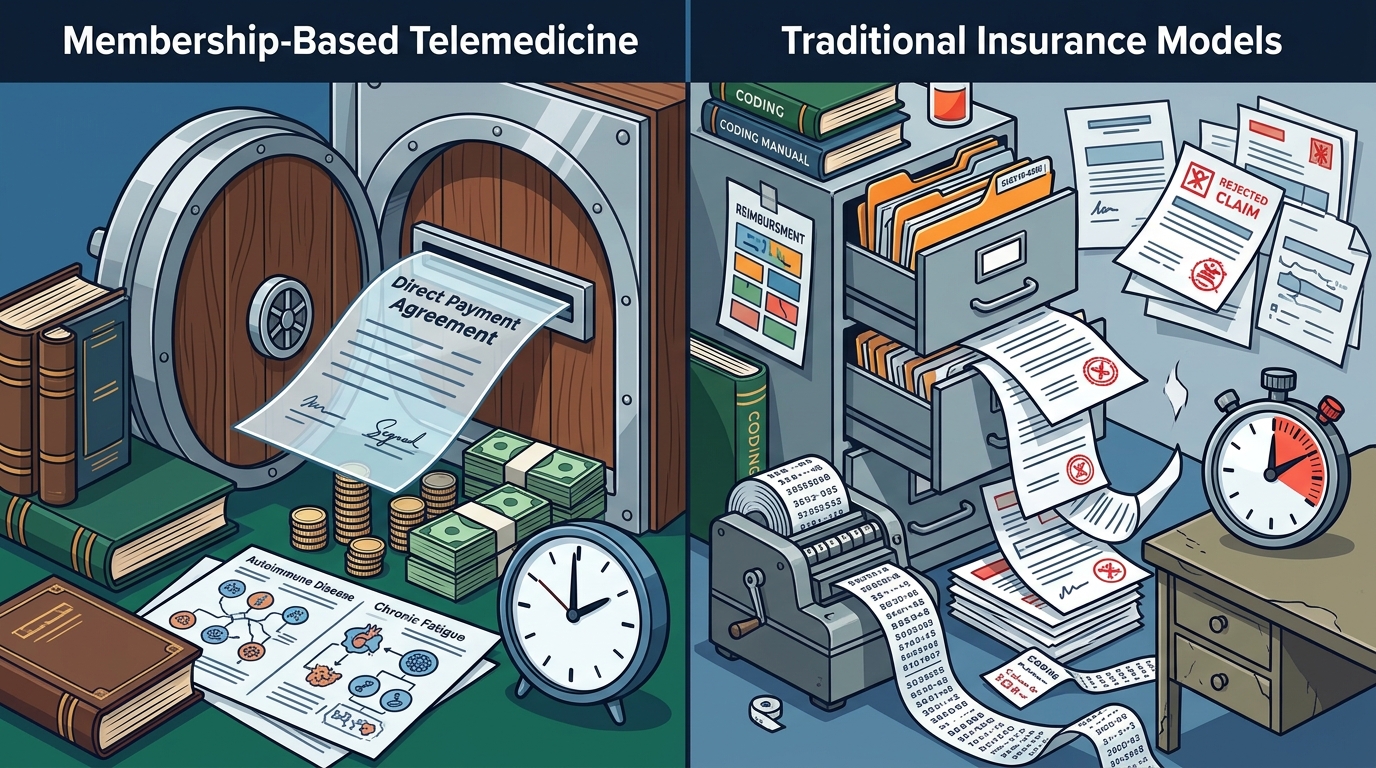
Membership-based telemedicine is a direct financial agreement between a patient and a physician for ongoing consultative care, bypassing third-party insurance billing. This model prioritizes clinical time and root-cause investigation over administrative volume. Traditional insurance models, by contrast, rely on reimbursement codes that often limit appointment length and restrict the depth of diagnostic workups available to patients with complex chronic conditions.
Structural Differences in Care Delivery
The fundamental difference between these two models lies in the relationship between the provider and the payer. In a traditional insurance framework, the insurer dictates the terms of care through reimbursement rates and prior authorization requirements. In a membership-based telemedicine model, the patient pays a transparent monthly fee directly to the physician. This direct relationship removes the administrative friction that typically slows down clinical decision-making.
Traditional insurance appointments are often capped at 15 to 20 minutes to maximize provider throughput. This time constraint makes it difficult to conduct the detailed history-taking and lifestyle analysis required for functional medicine. Membership-based practices, such as Direct Integrative Care, structure their time to allow for deeper engagement. This shift in structure allows for a more thorough exploration of a patient's unique biological context.
Administrative Burden vs. Clinical Focus
Physicians in insurance-based practices spend a significant portion of their day on documentation and billing codes. This administrative burden can detract from the quality of the patient-provider interaction. In a direct membership model, the focus remains on the clinical conversation and the development of a personalized care plan. The removal of billing codes allows the physician to choose the most appropriate diagnostic tools without worrying about reimbursement eligibility.
Clinical Depth and Diagnostic Freedom
Functional medicine requires a systems-based approach to diagnosis, often referred to as the Functional Medicine Matrix. This process involves mapping the interconnected roots of illness across biology, environment, and lifestyle. Insurance models frequently restrict access to the comprehensive lab panels needed to complete this matrix. Membership-based telemedicine offers the freedom to order targeted diagnostics that align with the patient's specific symptoms and history.
For conditions like autoimmune disorders or chronic fatigue, the root cause is rarely a single factor. It often involves a combination of gut health, mitochondrial function, and immune dysregulation. A physician in a membership model can adjust the diagnostic strategy in real-time based on how the patient responds to initial interventions. This iterative process is difficult to sustain within the rigid constraints of a traditional insurance visit cycle.
The Role of Telemedicine in Root-Cause Medicine
Telemedicine serves as the primary delivery channel for many membership-based practices. This modality allows for frequent check-ins and rapid adjustments to treatment plans. Patients can communicate with their physician via secure messaging between visits, ensuring that questions are answered promptly. This level of accessibility is rarely available in insurance-based practices, where communication is often limited to scheduled appointments or slow portal responses.
Financial Transparency and Predictability
One of the most significant advantages of the membership model is financial predictability. Patients know exactly what their monthly fee covers, and there are no surprise bills or deductibles to navigate. In contrast, traditional insurance involves a complex web of copays, deductibles, and out-of-pocket maximums that can be difficult to track. The membership model simplifies the financial relationship, allowing patients to budget for their health with greater certainty.
It is important to note that membership fees typically cover physician consultation and care coordination. They do not usually cover the cost of laboratory testing, medications, or third-party services. Patients are still responsible for these costs, which may be billed directly to them or to their insurance if applicable. This transparency helps patients understand the true cost of their care and make informed decisions about their health investments.
Comparison of Cost Structures
While the upfront cost of a membership may seem higher than a standard insurance copay, the total cost of care can be lower when considering the depth of service provided. Insurance patients often face multiple specialist visits and extensive testing to reach a diagnosis. A membership-based approach aims to streamline this process, potentially reducing the total number of visits and tests required over time.
Patient Experience and Continuity of Care
Continuity of care is a critical component of effective chronic disease management. In insurance-based systems, patients often see different providers for different issues, leading to fragmented care. Membership-based telemedicine provides a single point of contact for the patient's integrative health needs. This continuity allows the physician to develop a deep understanding of the patient's health trajectory and preferences.
The patient experience in a membership model is characterized by a collaborative partnership. The physician acts as a consultant, working alongside the patient's primary care provider to address complex health challenges. This collaborative approach ensures that the patient receives comprehensive support without the need to navigate multiple disconnected healthcare systems.
Addressing Complex Chronic Conditions
Patients with conditions such as mast cell activation syndrome or mold-related illness often struggle to find providers who understand their unique needs. Membership-based practices often specialize in these complex areas, offering the expertise and time required to manage them effectively. This specialization is a key differentiator from general insurance-based practices, which may lack the resources or training to address such nuanced conditions.
Key Takeaways
- Membership-based telemedicine is a direct financial agreement between patient and physician, bypassing insurance billing.
- This model prioritizes clinical time and depth over administrative volume, allowing for more thorough root-cause investigation.
- Financial transparency is a major advantage, with predictable monthly fees and no hidden deductibles or copays.
- Telemedicine enables frequent check-ins and rapid communication, enhancing the continuity of care.
- Membership fees typically cover consultation and care coordination, but not labs, medications, or third-party services.
- The model works best as a consultative service alongside a primary care physician, not as a replacement for acute or emergency care.
Frequently Asked Questions
Is membership-based telemedicine a replacement for health insurance?
No, membership is a direct agreement for physician consultation services. It is not health insurance and does not satisfy legal requirements for health coverage. Members are strongly encouraged to maintain separate health insurance for hospitalization and emergency care.
What services are included in a membership fee?
Membership fees typically cover physician consultation, care coordination, and access to secure messaging. They do not cover laboratory testing, imaging, medications, or supplements, which are billed separately.
Can I use my membership with my primary care physician?
Yes, the membership model is designed to work alongside your primary care physician. The integrative physician acts as a consultant, collaborating with your primary care provider to address complex health issues.
How does telemedicine work in a membership model?
Care is delivered via secure video or telephone consultations. This allows for frequent check-ins and rapid communication, ensuring that the care plan can be adjusted in real-time based on the patient's progress.
What conditions are best suited for membership-based care?
Membership-based care is particularly beneficial for complex chronic conditions such as autoimmune disorders, chronic pain, and metabolic dysfunction. These conditions require time and depth that are often unavailable in standard insurance appointments.
Do I need to be in a specific state to use telemedicine?
Yes, you must be physically located in a state where the physician holds an active medical license at the time of each consultation. This ensures compliance with state medical practice regulations.
Conclusion
Membership-based telemedicine offers a compelling alternative to traditional insurance models for patients seeking deeper, more personalized care. By removing the administrative barriers of insurance billing, this model allows physicians to focus on the root causes of chronic disease. For patients with complex health challenges, the investment in a membership can lead to a more effective and satisfying healthcare experience. Direct Integrative Care provides this consultative approach through a secure telemedicine platform, ensuring that patients receive the attention and expertise they need. Learn more: Functional Medicine Integrative Functional.