
Concierge Functional Medicine Costs vs. Traditional Insurance: A 2026 Financial & Clinical Breakdown
The traditional healthcare model is breaking down for patients with complex chronic conditions. According to recent analyses by the National Academy of Medicine, administrative burdens and insurance-driven visit limits consume a disproportionate share of physician time, leaving little room for the deep diagnostic work required to treat chronic illness. This structural mismatch is driving millions of Americans toward alternative care models that prioritize time over transaction. The direct integrative medicine membership model has emerged as a direct response to this failure, decoupling care quality from insurance reimbursement timelines. (Functional Medicine Integrative Functional)
The Hidden Costs of Traditional Insurance Care
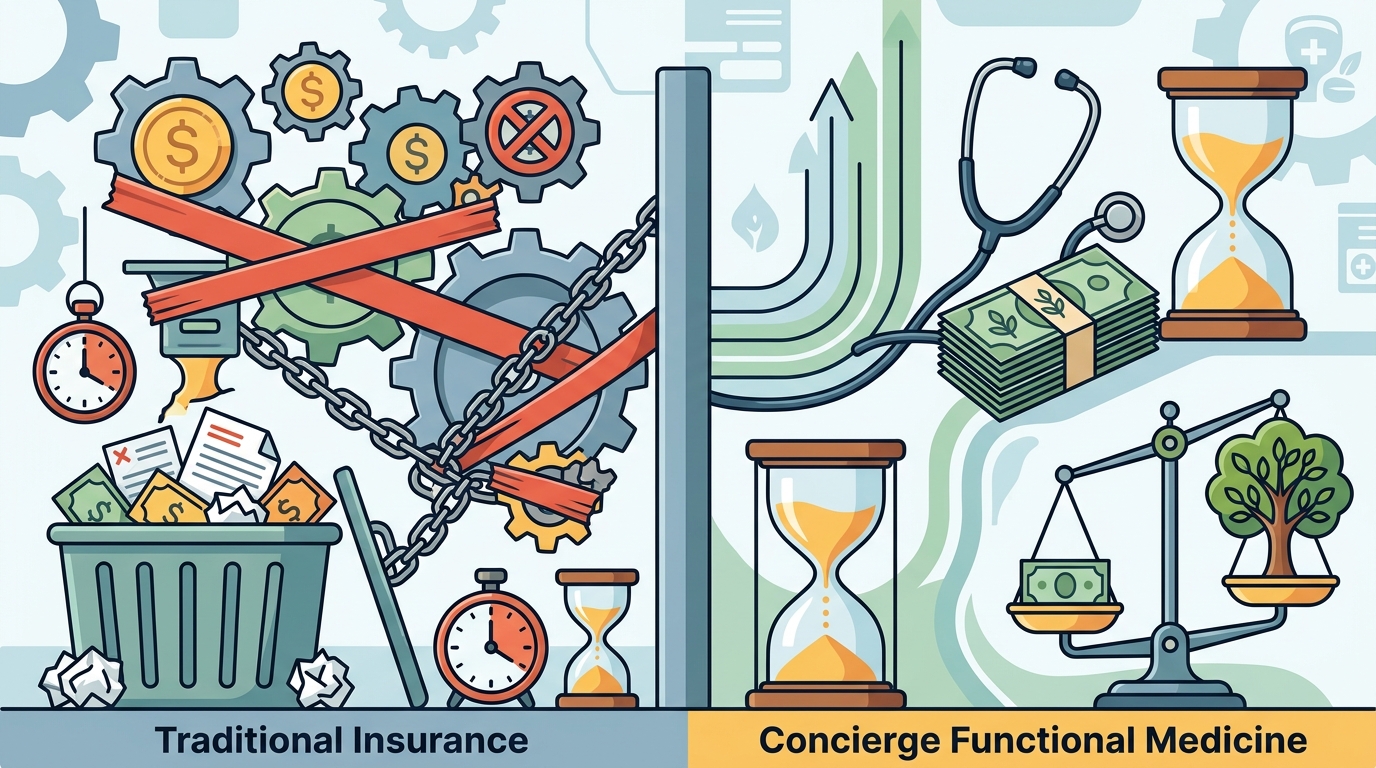
When patients compare concierge functional medicine costs vs. traditional insurance, they often look only at the monthly premium or copay. However, the true cost of traditional care includes significant hidden inefficiencies. In a standard insurance-based practice, physicians spend as much time on billing codes and prior authorizations as they do on clinical decision-making. This administrative burden compounds the problem, leading to rushed appointments that rarely address the root causes of chronic disease.
For patients managing conditions like autoimmune disorders, metabolic dysfunction, or hormonal imbalances, the 15-minute appointment window is a billing standard, not a clinical one. Research highlighted by the National Academy of Medicine confirms that scheduling inefficiencies and documentation demands pull focus away from actual patient care. Consequently, patients often face a cycle of trial-and-error treatments, repeated lab work, and specialist referrals that add up to thousands of dollars annually without resolving the underlying issue.
Furthermore, traditional insurance models are built around acute care: diagnose a symptom, prescribe a treatment, move on. This approach consistently falls short for complex cases that require time, context, and coordinated investigation. The result is patient dissatisfaction and a growing demand for a system that values longitudinal health over episodic intervention.
Understanding Direct Care Membership Models
Direct care membership models offer a fundamentally different financial structure. Instead of relying on insurance reimbursements, patients pay a flat monthly or annual fee directly to the practice. This model allows practitioners to focus entirely on the patient rather than the payer. The fee schedule for direct care at practices like Direct Integrative Care outlines transparent pricing that covers comprehensive services, including extended visits, lab coordination, and ongoing support.
This model is particularly effective for patients with complex conditions such as MCAS, Lyme disease, chronic fatigue syndrome, and toxic mold illness. These conditions do not fit into standard insurance protocols, which often deny coverage for the specialized testing and lifestyle interventions required for recovery. By opting for a direct care membership, patients gain access to high-touch, evidence-informed care tailored to their specific needs.
Dr. Yoon Hang Kim, a recipient of the 2024 Functional Medicine for All scholarship from the Institute for Functional Medicine, brings over 20 years of experience to this model. His approach combines functional medicine lab testing with complementary therapies such as meditation, yoga, tai chi, and lifestyle interventions. This holistic framework addresses the root causes of disease, offering a path to health that traditional insurance often overlooks.
The Functional Medicine Matrix: Diagnosis as Deep Work
Functional medicine operates through what practitioners call the Functional Medicine Matrix, a systems-based diagnostic map that tracks the interconnected roots of illness across biology, environment, lifestyle, and history. Mapping that matrix takes time. A patient with mold toxicity, for example, may present with fatigue, cognitive fog, and hormonal disruption simultaneously. Untangling those threads requires comprehensive intake assessments, detailed lab reviews, and iterative clinical conversations that simply cannot happen inside a 15-minute fee-for-service window.
Time is not a luxury in integrative medicine; it is a treatment modality. Practitioners who have 60 to 90 minutes with a patient can adjust a protocol in real time, explain the "why" behind each intervention, and monitor subtle shifts that would otherwise be missed. In practice, this depth of engagement is what separates a plan that patients actually follow from one they abandon by week two. The AAFP Whole Health Summit has consistently highlighted this longitudinal relationship as central to whole-health outcomes.
Conventional medicine meets alternative therapies under one roof in leading integrative clinics. This coordination is critical for patients who have been failed by the standard system. By removing the insurance barrier, direct care allows for the use of advanced diagnostic tools and personalized treatment plans that are often excluded from traditional coverage.
Comparing the Models: Cost, Time, and Outcomes
When evaluating concierge functional medicine costs vs. traditional insurance, it is essential to look at the total value proposition. The table below summarizes the key differences between the two approaches.
| Feature | Traditional Insurance Model | Direct Care Membership Model |
|---|---|---|
| Visit Length | 10-15 minutes | 60-90 minutes |
| Access to Physician | Appointment-based, often delayed | Direct messaging, same-day availability |
| Diagnostic Depth | Standard panels, limited scope | Comprehensive functional lab testing |
| Focus | Acute symptom management | Root cause resolution |
| Cost Structure | High deductibles, copays, surprise bills | Transparent flat monthly/annual fee |
The direct integrative model represents something fundamentally different from what most people think of when they hear "membership medicine." It is not simply about skipping the waiting room or getting same-day appointments, though those matter. It is about rebuilding the entire clinical framework around how chronic disease actually works. For patients in San Antonio, Texas, or those accessing telemedicine services in Quincy, Illinois, this model offers a viable path to recovery that traditional insurance cannot provide.
Dr. Kim's practice, located at 18756 Stone Oak Pkwy, Ste 200, San Antonio, TX 78258, exemplifies this commitment to personalized care. By offering virtual assessments and ongoing support, the practice ensures that patients receive consistent guidance regardless of their location. This accessibility is a key advantage of the direct care model, which prioritizes patient outcomes over volume.
Key Takeaways
- Administrative Burden: Insurance-driven practices spend excessive time on billing, reducing clinical time for patients.
- Visit Duration: Traditional visits average 15 minutes, while direct care offers 60-90 minute deep-dive sessions.
- Root Cause Focus: Functional medicine uses the Functional Medicine Matrix to address interconnected biological and environmental factors.
- Cost Transparency: Direct care memberships provide predictable pricing, avoiding the unpredictability of insurance deductibles and copays.
- Accessibility: Telemedicine options allow patients in remote areas, such as Quincy, IL, to access specialized care.
- Clinical Outcomes: Longer visits and comprehensive testing lead to more effective, personalized treatment plans.
- Physician Expertise: Dr. Kim's 20+ years of experience and certifications in integrative medicine ensure high-quality care.
Frequently Asked Questions
What is the cost of a direct care membership?
The cost varies by practice and the level of service provided. Direct Integrative Care offers transparent fee schedules that cover comprehensive services, including extended visits and lab coordination. Patients can view the current fee schedule on their website.
How does functional medicine differ from traditional medicine?
Functional medicine is a systems-based approach that focuses on identifying and addressing the root causes of disease. Traditional medicine often focuses on symptom management and acute care. Functional medicine uses the Functional Medicine Matrix to map interconnected factors like biology, environment, and lifestyle.
Is direct care available via telemedicine?
Yes, many direct care practices, including Direct Integrative Care, offer telemedicine services. This allows patients in locations like Quincy, Illinois, to receive personalized, concierge-style care from the comfort of their homes.
What conditions are best treated with functional medicine?
Functional medicine is particularly effective for complex chronic conditions such as autoimmune disorders, chronic fatigue syndrome, Lyme disease, MCAS, and toxic mold illness. These conditions often require the deep diagnostic work that traditional insurance models cannot support.
How do I contact Direct Integrative Care?
You can contact Direct Integrative Care by phone at (210) 981-6106, via text at the same number, or by email at directintegrativecare@hush.com. They also offer a Virtual Assessment Form for prospective patients.
What is the Functional Medicine Matrix?
The Functional Medicine Matrix is a diagnostic tool that maps the interconnected roots of illness across biology, environment, lifestyle, and history. It helps practitioners understand the complex web of factors contributing to a patient's health issues.
Can I use insurance with a direct care membership?
Direct care memberships are typically paid out-of-pocket. However, some practices may offer super bills that patients can submit to their insurance for potential reimbursement. It is best to check with your specific insurance provider and the practice for details.
Take Control of Your Health Today
The choice between concierge functional medicine costs vs. traditional insurance is not just financial; it is a choice about the quality of care you receive. If you are struggling with complex chronic conditions and feel limited by the traditional healthcare system, it may be time to explore a direct care membership. Dr. Yoon Hang Kim and the team at Direct Integrative Care are dedicated to helping patients uncover root causes and balance health using targeted diagnostics, supplements, and lifestyle interventions.
Take the first step toward a healthier future. Schedule your virtual assessment today by visiting the Virtual Assessment Form or contacting the clinic directly at (210) 981-6106. Experience the difference of personalized, evidence-informed care that puts you first.