

Why Does Functional Medicine Telemedicine Cost Differ From Traditional Clinics?
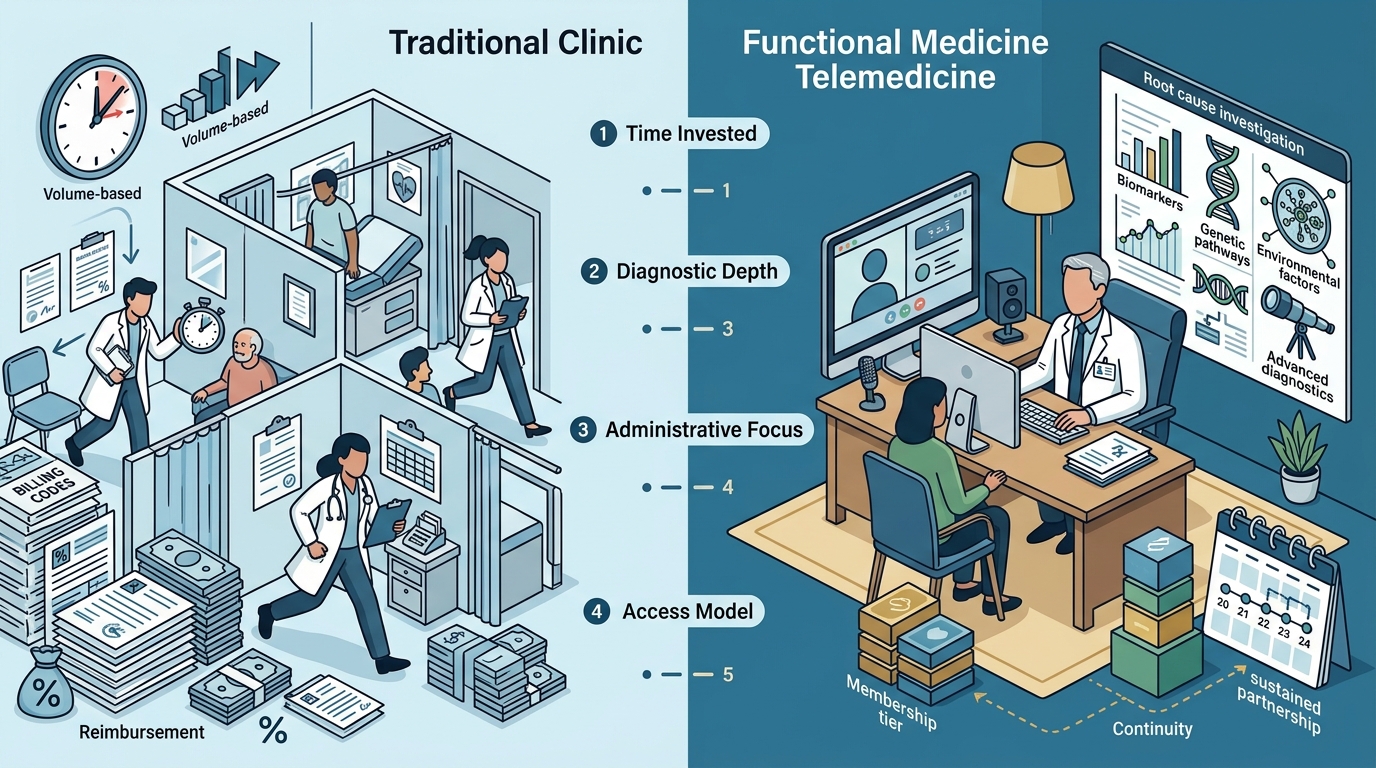
Functional medicine telemedicine often costs more per visit than traditional clinics because it prioritizes extended consultation times, advanced diagnostics, and continuous physician access over high-volume, brief appointments. Traditional fee-for-service models rely on short, billable encounters, whereas membership-based telemedicine practices like Direct Integrative Care use transparent monthly fees to fund deeper root-cause investigations and sustained patient-physician partnerships.
Structural Cost Differences in Care Models
The fundamental driver of cost variance lies in how physician time is allocated and billed. Traditional clinics operate on a fee-for-service structure where a standard appointment is typically limited to 15 to 20 minutes. This brief window is designed to maximize the number of patients seen per day, which keeps the per-visit price lower but limits the depth of clinical inquiry. In contrast, functional medicine telemedicine often utilizes a membership or direct care model. This approach replaces per-visit billing with a recurring monthly fee that covers a broader range of services, including extended initial consultations and ongoing communication.
Diagnostic Depth and Advanced Testing
Functional medicine is a systems-based approach that focuses on identifying the root causes of disease rather than merely managing symptoms. This diagnostic depth requires more than standard blood panels. Practitioners often order specialized tests, such as organic acid tests, micronutrient panels, or comprehensive stool analyses, to map out metabolic and immune imbalances. These advanced diagnostics are significantly more expensive than the routine labs ordered in traditional settings.
Telemedicine Economics and Access
Telemedicine introduces unique economic factors that influence pricing. On one hand, virtual care reduces overhead costs associated with physical office space, front-desk staff, and in-person equipment. This reduction in overhead can theoretically lower costs for the patient. On the other hand, telemedicine requires robust technology infrastructure, secure data transmission, and specialized training for clinicians to deliver high-quality care remotely. These technology investments are often factored into the membership fee.
Furthermore, telemedicine expands access for patients in rural or underserved areas. For a patient in a location where the nearest functional medicine specialist is hours away, the cost of travel, lodging, and lost work time for in-person visits far exceeds the cost of a telemedicine membership. In this context, telemedicine is often less expensive overall because it eliminates indirect costs. A study published in the Journal of Medical Internet Research highlights that telemedicine is often a less expensive and more convenient way to obtain healthcare without the indirect costs associated with in-person hospital visits.
The Specialist Premium and Expertise
The cost of functional medicine telemedicine also reflects the specialized expertise of the practitioner. Many functional medicine physicians hold additional board certifications, such as in integrative medicine, preventive medicine, or medical acupuncture. This advanced training requires significant time and financial investment, which is reflected in their service rates. Traditional primary care physicians, while highly skilled, may not have the same depth of training in complex, multi-system chronic conditions.
For instance, a physician who has completed a fellowship at a renowned integrative medicine center and holds certifications from the American Board of Integrative and Holistic Medicine will typically command a higher fee than a general practitioner. This premium pays for the specialized knowledge required to navigate conditions like mast cell activation syndrome, autoimmune disorders, or chronic fatigue. Patients are essentially paying for a higher level of clinical reasoning and a broader therapeutic toolkit, which includes both conventional and integrative modalities.
Membership Models vs. Fee-for-Service
The distinction between membership-based care and fee-for-service is the most significant factor in perceived cost. In a fee-for-service model, every interaction, including phone calls and emails, may be billed separately or not covered at all. This creates a barrier to communication, as patients may hesitate to reach out with questions due to cost concerns. In a membership model, the monthly fee covers a defined set of services, such as a certain number of visits and unlimited messaging. This all-inclusive approach provides predictability and encourages frequent, low-friction communication.
For patients with complex chronic conditions, the ability to message their physician between visits is invaluable. It allows for real-time adjustments to treatment plans, which can prevent minor issues from escalating. While the monthly membership fee may seem higher than a single traditional visit, it often results in better health outcomes and reduced unnecessary testing or emergency room visits. The cost is not just for the appointment; it is for the ongoing partnership and continuity of care that traditional models struggle to provide.
Key Takeaways
- Functional medicine telemedicine often costs more per visit due to extended consultation times and advanced diagnostic testing.
- Membership models replace per-visit billing with a transparent monthly fee, providing predictable costs and enhanced access.
- Telemedicine reduces indirect costs like travel and lodging, making it a cost-effective option for patients in rural areas.
- The specialist premium reflects advanced training and expertise in complex, multi-system chronic conditions.
- Advanced functional medicine labs are more expensive than standard panels but provide a deeper understanding of root causes.
- Membership fees typically do not cover laboratory testing, medications, or third-party services, which are billed separately.
Frequently Asked Questions
Is functional medicine telemedicine covered by insurance?
Most functional medicine telemedicine practices operate on a membership or direct care model, which is not covered by traditional health insurance. Members pay a monthly fee directly to the practice. It is recommended that members maintain separate health insurance for hospitalization, emergency care, and services outside the practice.
Why are functional medicine labs more expensive?
Functional medicine labs use optimal ranges rather than standard reference ranges and often include a broader panel of biomarkers. This comprehensive approach requires more complex testing methodologies, which increases the cost compared to routine primary care labs.
Does telemedicine cost less than in-person visits?
Telemedicine can be less expensive overall because it eliminates indirect costs such as travel, parking, and lost work time. However, the direct cost of the consultation may be similar to or slightly higher than an in-person visit due to the technology infrastructure required.
What is included in a functional medicine membership?
A membership typically includes a set number of visits, unlimited messaging, and access to the physician for ongoing support. It does not usually include laboratory testing, medications, or third-party services, which are billed separately.
Can I use my HSA or FSA for membership fees?
Many Health Savings Accounts (HSA) and Flexible Spending Accounts (FSA) allow members to pay for direct care membership fees. However, eligibility can vary, so it is important to consult with your tax advisor and check with your specific HSA or FSA provider.
Conclusion
Understanding the cost drivers of functional medicine telemedicine helps patients make informed decisions about their care. The higher costs are often justified by the depth of diagnostic work, the expertise of the practitioner, and the enhanced access provided by a membership model. For patients with complex chronic conditions, this investment can lead to better health outcomes and a more sustainable path to wellness. Direct Integrative Care offers a transparent membership structure that aligns with these principles, providing high-touch, evidence-informed care through telemedicine.